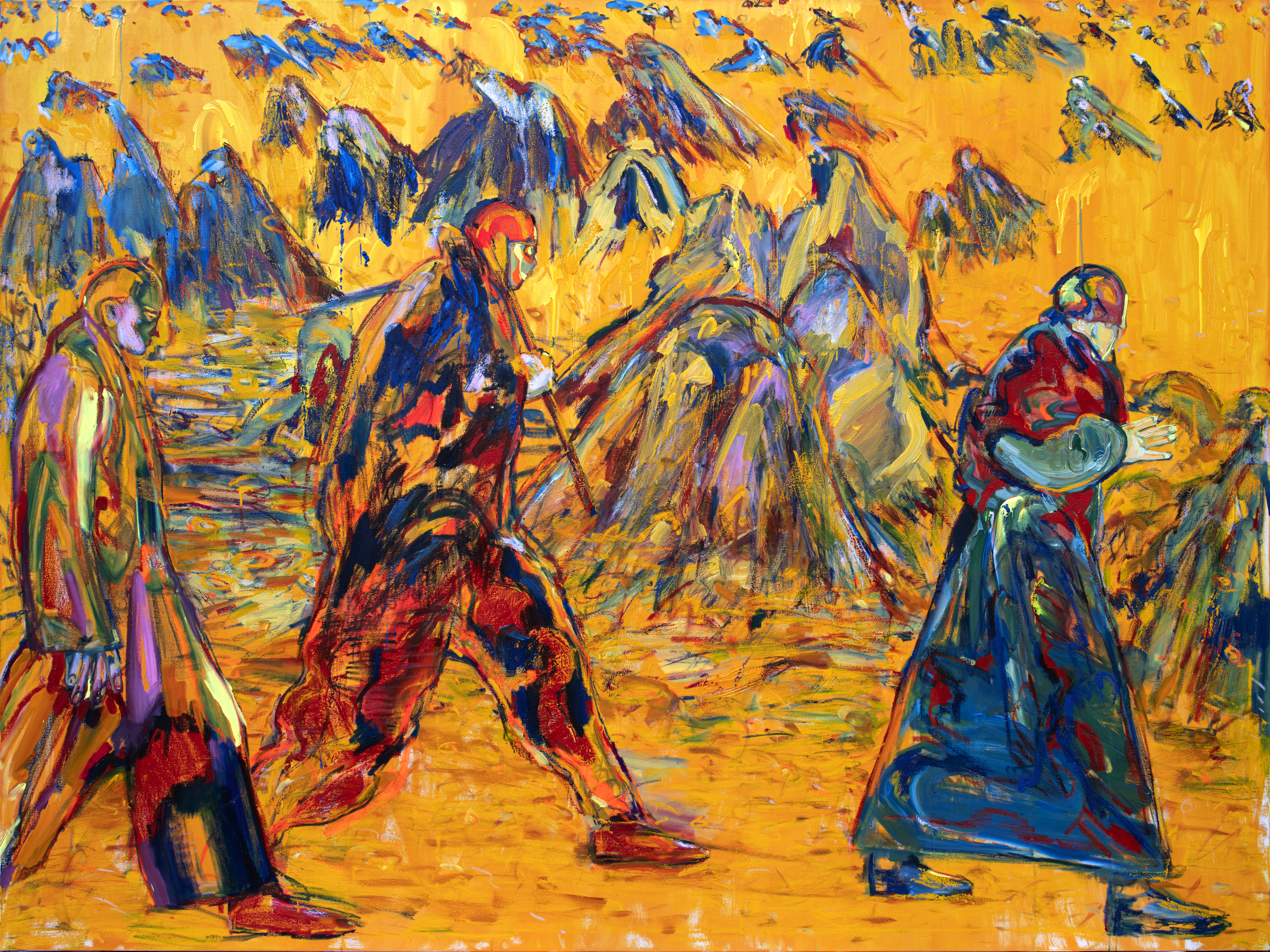
The Gathering, Pilgrims
— Project Bystanders
2021
Pigment Bar on Canvas
193.9 × 259.1 cm (76 3/8 × 102 in)
Private collection, South Korea
The Conditions of Pilgrimage
On Jaeyeol Han’s Pilgrims
Three figures are crossing a yellow field. They wear long, seemingly heavy garments, with their heads covered by what might be hoods or hats. The figure on the left stands relatively upright, while the central figure leans forward, apparently holding something resembling a long staff. The figure on the right wears a long blue garment, with overlapping fields of colour forming the upper body and face. Yet these few details tell us little about who they are, where they have come from or where they are going. Their faces are difficult to identify, and their clothing provides no reliable indication of a particular period or geographical location. Nevertheless, there is a clear sense that all three figures are moving in the same direction. What we recognise first in this painting is not their identity, but their movement.
The title identifies them as pilgrims. Pilgrimage generally presupposes a destination. It is not simply a journey from one place to another, but an undertaking directed towards a particular belief or value. Yet Han does not reveal their destination. There are no identifiable religious symbols, no visible place of arrival and no specific event that might explain their movement. All the viewer knows is that these figures are called pilgrims. What distinguishes them from travellers, migrants or wanderers lies less in the visual evidence than in the meaning supplied by the title. This gap is not merely an absence of information. It shifts our understanding of pilgrimage away from a particular religious event towards a more general human condition: that of continuing to move towards something.
The surrounding landscape is equally resistant to identification. Expanses of yellow and orange suggest a field, yet the dark shapes rising from the ground might be stacks of straw, small hills or even tents. Some resemble other human figures in the distance. Scattered dark marks across the upper part of the canvas could suggest birds in flight or objects carried by the wind, but they never settle convincingly into either interpretation. The visual signs that constitute the landscape are familiar enough to be recognised, yet insufficient to establish a definite place.
This uncertainty, however, does not make the painting incomplete. Within the intense yellow field, bodies composed of blue, red and other colours acquire weight and direction. The landscape is not simply a backdrop against which the figures move. Its yellow extends across much of the canvas, establishing a continuous pictorial space in which the three bodies appear together. Colour also complicates the distinction between figure and ground: the figures are differentiated by their chromatic contrasts, yet they are not entirely detached from the surrounding field. Their presence depends upon the same pictorial relationships that give the landscape its form. The ground they traverse lends their movement a sense of direction, even though the place itself remains unidentified. Han establishes a convincing pictorial reality without reproducing a recognisable location. Its coherence arises from the relationships within the painting rather than from its resemblance to the world outside it.
This quality connects Pilgrims to Han’s longstanding exploration of the human figure. In Passersby, he has investigated whether a figure can retain its presence after facial resemblance and the features by which someone might be identified have disappeared. In Bystanders, this enquiry extends to relationships between people. Bodies overlap and separate, while the boundaries of one figure are repeatedly redefined by the forms surrounding it. The three figures in Pilgrims remain relatively distinct. Yet what brings them together within a single scene is not their individual identities. Their apparent movement in the same direction, together with the space they occupy, establishes a relationship. We do not know their names or whether they share the same beliefs, yet the painting places them within what appears to be a shared journey.
What is particularly interesting is that the three figures do not necessarily appear to constitute a community. They neither look at one another nor hold hands. Each body has a different posture and weight, and it is unclear whether the figures are even conscious of one another’s presence. Nevertheless, we read them as people travelling together rather than as three unrelated individuals. The painting raises the possibility that community need not depend upon intimate contact or clearly defined belonging. Moving in the same direction may be enough to bring people, however briefly, into a shared relationship. Yet nothing in the painting establishes that they are pursuing the same destination. Moving together and believing in the same thing are not identical.
The painting’s colour makes this movement more complex. The brilliant yellow landscape might evoke an abundant season or intense sunlight, yet the figures’ clothing and postures sit uneasily with its brightness. Their garments appear thick, their bodies heavy, and the central figure leans forward in the apparent direction of travel. There is no need to interpret this contrast immediately as a symbol of hardship or hope. The brightness of the landscape and the apparent weight of the bodies coexist without resolving into a single emotional register. Nor does yellow function merely as an atmospheric description. Its dominance holds the figures within a common space, while the contrasting colours of their bodies preserve their differences. The viewer moves between the luminosity of the landscape and the physical presence of the figures, continually reconsidering the character of the scene.
Above all, the painting withholds an explanation of any particular event. Because we do not know the figures’ destination, the meaning of their movement remains uncertain. We are not told what they are approaching, what they have left behind or how they are related to one another. This absence of explanation redirects our attention towards the painting itself: the placement of their feet, the direction of their garments, the inclination of their bodies and the distances between them. Rather than identifying who is going where, we begin to consider how moving bodies establish a pictorial relationship. The painting does not simply convey the emotions of its figures. It draws the viewer into a process of looking, questioning and revising what initially seemed recognisable. The uncertainty of the scene becomes a condition of our engagement with it.
Han’s Pilgrims may be less concerned with the history of religious faith or the story of a particular group than with the possibility that people whose beliefs remain unknown can nevertheless appear to move together, and that this movement can establish a relationship. Their faces are indistinct, and the landscape belongs to no identifiable location, yet their passage acquires a convincing reality within the painting. We can encounter these moving bodies without knowing who they are. The title brings three figures, who might otherwise have appeared as unrelated strangers, into a single pictorial world. Within that world, human presence precedes identity or belonging, and relationships can take shape without a narrative to explain them. The painting does not reveal what the figures believe, or even whether their beliefs are shared. What it makes visible is how a journey can appear to be held in common without the certainty of a common destination or purpose.
순례의 조건
한재열의 순례자에 관하여
세 사람이 노란 들판을 지나고 있다. 그들은 길고 무거워 보이는 옷을 입었고, 머리에는 후드나 모자처럼 보이는 것이 씌워져 있다. 왼쪽 인물은 비교적 곧게 서 있는 반면, 중앙의 인물은 몸을 앞으로 기울인 채 긴 막대기 같은 물체를 잡고 있는 것으로 보인다. 오른쪽 인물은 청색의 긴 옷을 입고 있으며, 상체와 얼굴을 구성하는 색면들이 서로 겹쳐 있다. 그러나 이러한 단서만으로 그들이 누구인지, 어디에서 왔으며 어디로 가는지 알 수는 없다. 인물들의 얼굴은 식별하기 어렵고, 복장 역시 특정한 시대나 지역을 확정해주지 않는다. 그럼에도 세 사람이 한 방향으로 이동하는 듯한 인상은 분명하다. 이 그림에서 먼저 인식되는 것은 사람들의 정체가 아니라 그들의 이동이다.
제목은 이들을 순례자라고 부른다. 순례라는 말에는 보통 목적지가 전제된다. 그것은 단순히 다른 장소로 이동하는 일이 아니라, 어떤 믿음이나 가치를 향해 길을 떠나는 행위다. 그러나 한재열은 그 목적지를 보여주지 않는다. 종교적 상징도, 도착해야 할 장소도, 이들의 이동을 설명할 만한 사건도 확인할 수 없다. 관람자가 아는 것은 그들이 순례자라고 불린다는 사실뿐이다. 그림에 나타난 세 사람을 여행자나 이주민, 떠돌이와 구별하는 것은 시각적 증거보다 제목이 부여한 의미에 가깝다. 이 간격은 단순한 정보의 결핍이 아니다. 순례를 특정한 종교적 사건으로 이해하는 대신, 무엇인가를 향해 계속 이동하는 인간의 상태로 바라보게 만든다.
배경의 풍경 역시 하나의 장소로 확정되지 않는다. 노란색과 주황색이 넓게 펼쳐져 있어 들판을 떠올리게 하지만, 곳곳에 솟아 있는 어두운 형상들은 볏짚을 쌓아놓은 더미일 수도 있고 작은 언덕이나 천막처럼 보이기도 한다. 일부는 멀리 있는 또 다른 사람의 몸을 닮았다. 화면 위쪽에 흩어진 짙은 자국들은 날아가는 새나 바람에 움직이는 사물을 연상시키지만, 그 어느 쪽으로도 쉽게 확정되지 않는다. 풍경을 구성하는 시각적 단서들은 충분히 익숙하면서도 하나의 장소를 특정하기에는 부족하다.
그러나 이러한 불확실성이 그림을 불완전하게 만드는 것은 아니다. 강렬한 황색의 공간 안에서 청색과 적색을 비롯한 여러 색으로 이루어진 신체들은 무게와 방향을 얻는다. 이때 풍경은 인물들이 이동하는 단순한 배경에 머물지 않는다. 화면 대부분을 차지하는 노란색은 세 인물을 하나의 연속된 공간 안에 놓는다. 색채는 인물과 배경의 구분도 복잡하게 만든다. 세 사람은 주변과 대비되는 색으로 구별되지만, 풍경으로부터 완전히 떨어져 있는 것도 아니다. 인물의 존재는 풍경을 형성하는 색과 구성의 관계 속에서 성립한다. 그들이 밟고 지나가는 지면은 이동의 방향을 느끼게 하지만, 그 장소가 어디인지는 여전히 알 수 없다. 한재열은 특정한 현실의 장소를 재현하지 않으면서도 하나의 설득력 있는 회화적 세계를 만들어낸다. 그 세계의 현실성은 바깥의 풍경과 얼마나 닮았는가보다 화면 안에서 색과 형상이 어떤 질서를 이루는가에 달려 있다.
이러한 특징은 그가 오랫동안 다루어온 인간의 형상과도 연결된다. Passersby에서 한재열은 얼굴의 닮음과 신원을 알아볼 수 있는 단서들이 사라진 뒤에도 인물이 하나의 존재로 남을 수 있는지를 탐구해왔다. Bystanders에서는 그 질문이 사람들 사이의 관계로 확장된다. 신체는 다른 신체와 겹치고 분리되며, 한 인물의 경계는 주변의 형상에 의해 다시 결정된다. 순례자의 세 사람은 비교적 구분된 신체를 갖고 있다. 그러나 그들을 하나의 장면으로 묶는 것은 개별적인 정체성이 아니다. 같은 방향을 향해 움직이는 듯한 몸들과 그들이 차지하는 공간이 관계를 만든다. 서로의 이름을 알지 못하고, 같은 믿음을 공유하는지도 알 수 없지만, 그림은 이들을 하나의 여정을 함께하는 것처럼 보이게 한다.
여기서 흥미로운 것은 세 사람이 반드시 하나의 공동체로 보이지는 않는다는 점이다. 그들은 서로를 바라보거나 손을 잡지 않는다. 각자의 몸은 다른 자세와 무게를 갖고 있으며, 서로의 존재를 의식하고 있는지도 불분명하다. 그런데도 우리는 이들을 따로 떨어진 세 인물이라기보다 함께 이동하는 사람들로 읽는다. 공동체가 반드시 친밀한 접촉이나 분명한 소속으로만 성립하는 것은 아닐 수 있다. 한 방향으로 향한다는 사실만으로도 사람들은 잠시 같은 관계 안에 놓일 수 있다. 그러나 그들이 동일한 목적지를 향하고 있다는 근거는 그림 어디에도 없다. 함께 움직이는 것과 같은 것을 믿는 것은 다른 일이다.
그림의 색채는 이러한 이동을 더욱 복잡하게 만든다. 밝은 노란색의 풍경은 풍요로운 계절이나 뜨거운 햇빛을 떠올리게 하지만, 인물들의 자세와 복장은 그 밝음과 쉽게 어울리지 않는다. 옷은 두껍고, 몸은 무거워 보이며, 중앙의 인물은 이동하는 듯한 방향으로 상체를 기울이고 있다. 이 대비를 곧바로 고난이나 희망의 상징으로 해석할 필요는 없다. 풍경의 밝음과 신체의 무게는 어느 하나의 감정으로 수렴하지 않은 채 공존한다. 노란색 역시 단순히 장면의 분위기를 묘사하는 데 그치지 않는다. 화면을 지배하는 황색은 세 인물을 하나의 공간 안에 묶으면서, 그 신체들을 구성하는 대조적인 색채는 각자의 차이를 유지한다. 관람자는 풍경의 밝음과 인물들의 물리적 존재감 사이를 오가며 장면의 성격을 계속 다시 판단하게 된다.
무엇보다 이 그림은 특정한 사건을 설명하는 일을 유보한다. 우리는 이들의 목적지를 알 수 없기 때문에 걸음의 의미를 확정하기 어렵다. 그들이 무엇을 향해 가는지, 무엇을 떠나왔는지, 서로 어떤 관계인지는 알려지지 않는다. 그러나 이러한 설명의 부재는 오히려 시선을 그림 자체로 돌린다. 인물의 발이 놓인 위치, 옷자락의 방향, 몸의 기울기와 그들 사이의 간격을 더 오래 살피게 되는 것이다. 누가 어디로 가는지를 확인하는 대신 이동하는 신체들이 어떻게 하나의 회화적 관계를 이루는지 생각하게 된다. 그림은 인물들이 느끼는 감정을 단순히 전달하지 않는다. 관람자가 바라보고, 의문을 품고, 처음에 알아보았다고 생각한 것을 다시 판단하도록 만든다. 장면의 불확실성은 그림을 이해하는 데 방해가 되기보다 오히려 그 그림과 관계를 맺게 하는 조건이 된다.
한재열의 순례자가 보여주는 것은 신앙의 역사나 특정한 집단의 이야기가 아닐 수 있다. 오히려 무엇을 믿는지 알 수 없는 사람들이 함께 움직이는 것처럼 보일 수 있다는 사실, 그리고 그러한 움직임을 통해 하나의 관계가 형성될 수 있다는 가능성에 가깝다. 세 사람의 얼굴은 불분명하고 풍경은 어느 장소에도 완전히 속하지 않지만, 그림 안에서 그들의 걸음은 충분한 현실성을 얻는다. 우리는 그들이 누구인지 알지 못해도 이동하는 몸들을 마주할 수 있다. 제목은 순례라는 말이 없었다면 서로 무관한 낯선 사람들로 보였을 세 인물을 하나의 회화적 세계 안에 놓는다. 그 세계에서 인간의 존재는 신원이나 소속보다 먼저 나타나며, 관계는 그것을 설명할 이야기가 없어도 성립할 수 있다. 그림은 이들이 무엇을 믿는지, 나아가 같은 믿음을 공유하는지조차 알려주지 않는다. 다만 목적지나 목적의 일치를 확인할 수 없는 상태에서도 하나의 여정이 어떻게 공동의 것으로 보일 수 있는지를 보여준다.